Showing posts with label Sue Dennis. Show all posts

Sunday, August 28, 2016

Bark Impressions

Bark Impressions
19.5"w x 30.5"long [49.5cm x 77cm]

It was great fun to revisit the crystal organza fabrics I had in the stash and use them to create the bark Impressions quilt. Many of the eucalypt trees in my suburban neighbourhood in Brisbane have interesting bark patterns, from which I took inspiration. A bit of paint to pattern the organza made the whole much more interesting as well as the interplay of shadowing when the sheer fabric was overlapped. A few fanciful bugs/insects were added to inhabit the bark.


Materials: synthetic organza, batting, cotton backing, yarn, thread, fusible web, fabric paint
Techniques: fusing, machine quilting, hand stitching, fabric manipulation, hand printed


Friday, July 22, 2016

What was I thinking!

Oh dear! I seem to have a lot of, what I would class as undesirables! These are synthetic fabrics bought for workshops or just because they were shiny and sparkly! They have been carefully stored, but no more- out they go! And hopefully a small part will be used to make a beautiful quilt!
Enhanced with fabric paint, ready for quilt construction. It is a journey into the unknown as I use these. Hoping my idea translates into an acceptable final product.
 

Tuesday, June 28, 2016

Women's Roles in Sapa, Vietnam

Visiting another country on holiday and seeing the many roles of the women of the Sapa region, Vietnam inspired my quilt design. Here the women are multi-skilled in farming, domestic duties and the production of their traditional clothing which their adorn with embroidery, patchwork or indigo batik. The women grow, process and weave hemp into lengths for clothing. They use natural indigo to dye the hemp cloth.
The Museum in Sapa had many story boards of the village production processes. It was fascinating reading.
Old textiles are recycled into bags, wall hangings, jackets etc  sold at the market by the women who often have started their day in the fields before walking long distances to sell items.
These are some of the recycled embroidered pieces made into neck pieces, based on those worn by women of the Black Hmong ethnic groups.
Back baskets carry everything needed for daily life and this was a common morning procession. We spent 9 days in the area and I bought a few small embroidered items, cut from clothing to use in my work so when the challenge was announced I was still in Sapa and thought about my designs for a quilt. I also had a piece of  batik fabric I had made a few years ago. This fabric piece had the family roles of women written on it- wife, mother, sister, aunt, daughter, grandmother and was a perfect inclusion. The women of Sapa work very hard in all their roles.
Women's Roles in Sapa, Vietnam
18"W x 40.5"L [46cm w x 102.5cm]
Women in Sapa, Vietnam work very hard in their family roles and those of farm worker and textile producer and seller. The batik text in the central section lists familial roles while the three short woven hemp, indigo dyed with embroidery strips, showcase their needle skills. I have reversed the strip under the batik to show the hidden side of the piece, just as we don't see all the women do in a day's work. The necklaces are stitched and hand painted over the batik section.
Detail
Materials: cotton, hemp, embroidery thread, wax, dye, paint, batting, thread.
Techniques: batik text hand drawn, hand painted, hand couched, hand woven fabric, machine pieced, machine quilted.


Sunday, May 15, 2016

Foreign language confusion

I have been fortunate to travel to many countries and still enjoy the excitement of new discoveries in foreign lands. Nothing is more indicative of a country than its way of communication through its language. It is impossible for me to learn the language of every country I visit, so a few words are picked up here and there, polite formalities and the all important word for 'toilet'.
In Vietnam there is a bombardment of signage on the streets advertising all manner of items. Some are easy to read and interpret especially when a picture or English translation is attached.
Others are just a guessing game.
Accompanied by graphic illustrations.
And just because!


Wednesday, April 27, 2016

The joy in green


The Joy of being Green
25 1/2" w x 39 1/2" [64cm w x 100.5cm]
I didn't fully appreciate this colour until I decided to work with it in this monochromatic challenge. My garden was the inspiration and I discovered all shades of green there, from limey light green, blue green through to grey green.
I hope the energy of living plants is conveyed in The Joy of being Green.

Materials: cotton, commercial fabrics, dye, oil paint sticks, fusible web, batting, threads
Techniques: hand dyed, rubbed, raw edge applique, machine pieced, machine quilted
   

Tuesday, March 8, 2016

Going green

Green is not my favourite colour, but I have been having fun playing with the many variations of this colour. Taking my garden as inspiration I dyed cotton fabric for a first layer and background of my design. My garden is in need for some care and attention, but I never seem to be home long enough.
Along the way I discovered a lot about this colour.
These are the first steps to completion. All will be revealed in April!
 

Saturday, February 27, 2016

Indigo #3

Indigo #3
18 3/4"w x 39 1/2"long [47.5cm x 100.5cm]
I have enjoyed combining 3 panels of indigo dyed cotton that I stitched before immersion, creating a resist pattern. This pattern is further enhance with hand stitching in white and red. The white prints use the abundant weeds I found in my garden. They grew unchecked while I was away in Mongolia.
Materials: cotton, indigo dye, textile ink, batting, threads
Techniques: hand dyed, hand printed, hand stitched, machine pieced, machine quilted.


Thursday, February 25, 2016

Be natural

In our fast paced world, the trend to eco dyeing and being more in touch with nature for our health and well being has me thinking about how my studio practice fits into this wider world view. I enjoy using the plants around me, mainly for printing but have been known to throw the odd vegetable scrape into a pot with fabric to see what results.
My recent time in Mongolia has alerted me to the use of the natural, non-dyed fibres from Sheep, Yak, Camels and Cashmere goats. Some examples shown above.
Indigo is also an extremely popular plant dye in many cultures and seems to be enjoying a resurgence in the Western world among textile practitioners.
For this challenge I invite you to explore the use of natural products to colour your fabric. Don't be shy- raid the spice shelf or kitchen pantry, pull up your weeds, order in indigo and get a witches brew bubbling!
 I look forward to seeing what  you come up with to use within your chosen theme. Happy New Year!
Length to be 40".

Friday, January 8, 2016

Yak/silk roving?


I'm on holiday, escaping the cold and sleet at home in CT for the cool and rain in San Pablo Bay CA.  Like most of you, when I'm away from home I explore museums, shops, restaurants, farmers markets, galleries and on and on.  Yesterday was exhilarating as I explored textile places in Berkley and into Oakland.  Check out www.averbforkeepingwarm.com. There were bunches of home grown indigo and marigolds hanging from the ceiling awaiting the dye vat.  My heart was aflutter...and I'm not a dyer...usually.

Among the items I 'had' to buy was yak/silk roving.  Oh, I could have bought plain silk roving or cotton roving (and I might still) but I landed on this weird...er...exotic...looking stuff.  And it feels so good too.

It's not really in my preferred color family, but it works so well with my personal challenge during the current V9-3 cycle and, more to the point, Sue Dennis' excellent challenge "Being Natural".  I have to find a way to incorporate this 'exotic' material.

Sunday, December 27, 2015

It's snowing in Ulaanbaatar

It's snowing in Ulaanbaatar
22"W x 40"L [55.5cm x 102cm]
During the last two months my neighbourhood changed from suburban Sunnybank, Australia to down town Ulaanbaatar, Mongolia. The seasons also changed from Summer to Winter!
Our view is from the sixth floor of an apartment block and the skyline of tall buildings changes with the time of day or fog, smog, snow or wind conditions. The dimensional challenge gave me the chance to gather, fold and manipulate synthetic fabrics I have had in the stash for some time.
Materials: cotton, silk, synthetics, threads, batting, textile ink
Techniques: mono printing, machine applique, gathering, manipulation, machine quilting, hand stitching and couching


Tuesday, October 27, 2015

Urban Wagga


Urban Wagga 
22”w x 40”L [56 cm x 101.5cm]

The “making do” Australian utilitarian quilts called “waggas” inspired the making of this modern, urban wagga. Using rusted cotton from my stash, I rubbed textured surfaces around my home and in the neighbourhood. An old quilt was repurposed as the base onto which I stitched sections using red thread and a machine utility stitch. The embroidered pieces came from a doily bought at my local thrift store.

 Materials; cotton, silk, dye, oil paint stick, rusty objects, old quilt reused, threads

Techniques; rust dyed, rubbed, indigo dyed, embroidery, machine applique, machine pieced, machine quilted


Monday, October 19, 2015

Australian Waggas

Australian patchwork tradition came with the first fleet convicts from England but mainly in the form of 2 layered coverlets. The Aboriginal use of possum skins and the making of cloaks from these is noted in the book above, The Gentle Arts -200 years of Australian Women's Domestic & Decorative Arts by Jennifer Isaacs 1987.
What sparks my interest and attention is the Bush Quilt or Wagga often made from scraps or suiting samples and stuffed with used clothing for warmth. Made during the late 19th and early 20th century they were used by men who worked the land or families as a utilitarian quilt. Dr Annette Gero in her book above, The Fabric of Society- Australia's Quilt Heritage from Convict Times to 1960 has a chapter on the wagga.
A wonderful photo of the maker and the Rabbiter's wagga

The innards of a wagga- old jumpers/cardigans.
Drawing inspiration from this tradition and technique I have used an older quilt as the base on which to build my design.
New material on the left and the original quilt on the right. This will be totally covered.
Design auditioning. Thanks Misik for the opportunity to look at the wagga tradition.


Friday, August 28, 2015

Seasonal Shift


Seasonal Shift

21 ¾” w x 40”L [55.5cm x 101.5cm]

I have been observing the seasonal colours in my neighbourhood and am amazed by the variety and number of flowering trees and shrubs even during a Queensland winter. Pale to rosy pink, bright and bold yellow, soft orange and many shades of green abound.

For Betty’s challenge I decided to work with a dyed merino wool pre-felt and black felt of unknown composition, as I hadn’t used these materials before in a quilt. It was interesting to note how the dense, soft wool fibres seemed to absorb light.

The felted piece was applied to the background with the corners and some of the other edges curling a little to mimic the exfoliating dead bark of the huge eucalypt near the local junior school.

Materials; cotton, batting, thread, wool, felt

Techniques; embellisher machine used for the felting, machine applique, machine quilted

Wednesday, August 12, 2015

Rethinking

Over the years I have incorporated some unusual materials into my quilts- plastics and plastic fishing lures and before it became more main stream used the wadding as a surface. But Betty is a hard act to follow with her wonderful incorporation of the unusual so I am rethinking my approach.
My theme is Around my Neighbourhood so I went back to this set of benches covered in the most fantastic ceramic pieces- a quilt in the making, but it would be heavy! The pieces have been impressed with native flowers and many of these trees grow near the bench seats.
A side view. Each side is covered and the colours are brighter as they are not so sun bleached.
I have taken an imprint on silk to use in my quilt with a few other "new" for me things to be used yet!


Saturday, June 27, 2015

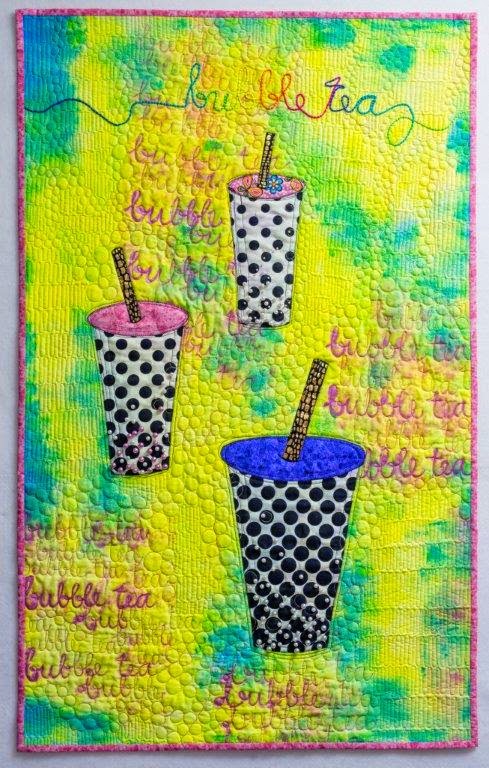
Bubble Tea

Bubble Tea
26"W x 41.5"L
Pearl or bubble tea is a drink that originated in Taiwan and is popular in my neighbourhood. I am always amazed and surprised by the variety of flavour and jelly combinations available, for example taro milk tea, green apple or lychee with pearls, rainbow or mango jelly.
The neon colour challenge encapsulates the variety of colours displayed on the drinks menu.
Materials; cotton, batting, thread, textile ink, fusible, cord, beads
Techniques; hand painted, hand couched and beaded, machine applique, machine quilted


Saturday, June 6, 2015

Better in colour

The world would be a dull place without colour and a touch of neon is so bright and pretty. Miss 5 must have thought so too as she played with my i pad.
Interesting to see the world through the eyes of the young. Thanks Hsin-Chen, I have had a lovely time with this challenge as I love bright colour too.


Monday, April 27, 2015

Chinese New Year

Chinese New Year
20"w x 48"L
In my neighbourhood Chinese New Year is a noisy, colourful affair with Lion dancing and feasting. 2015 is the Year of the Goat and as my Chinese animal year is also the goat I wanted to celebrate this in my quilt.

I enjoyed hand embroidering the details on the goat's head and creating the look of an old wall in the background. In Chinese culture colours symbolise various things and red is the colour of good fortune, joy and happiness.

Materials; cotton, batting, thread, dye, fusible, embroidery floss, textile ink
Techniques; hand dyed, stencilled, hand painted, hand embroidered, machine pieced, machine appliqued, machine quilted
Detail

Sunday, March 29, 2015

Around my neighbourhood

The theme I'm working with for this third round of challenges is Around my neighbourhood. I wanted to choose something that I wouldn't get bored with and that would give me the scope to use the surface design techniques I like, plus incorporate the interesting challenges that each member will give us. As I went for a morning walk around my neighbourhood my eyes were opened afresh to all the possibilities in the urban, cultural and natural environments within a short distance from my home!
The challenge to use thread in a new way has taken me more deeply into hand embroidery. I have slowly been adding hand stitching to some of my latest quilts and this is a good excuse to expand out from running and seed stitch.