Tuesday, October 27, 2015

Windows and Doors

Windows and Doors, 9 patch detail
After seeing the International Quilt Study Center and Museums exhibit of log cabin quilts at the European Patchwork Meeting, I was sure I was going to interpret that pattern with some lovely hand-dyed reclaimed linens, luscious silks, and remnant bits from fabric manufacturer, Malfroy, that I'd collected from the vendors.  Sparked by Kate's discussion about American Art, I investigated the history of the log cabin pattern more closely and found that, despite popular belief (mine included), the log cabin pattern can be traced back to Egyptian tombs and first interpreted in fiber, back in18th century Europe.  Regardless, I think many would consider it a traditional American quilt pattern - - so in that spirit, I forged ahead (although I was really tempted by Kate's post….).

Windows and Doors, window detail
Using "traditional" 9 patch and log cabin designs as a starting point, I reflected on my cycle theme. So many of my family, friends and loved ones are at crossroads, or in transition, contemplating which door to open (or which window to climb out).  I know this is part of the cycle of life we all experience once and again.  It makes me aware of how many ways life can be played, how one choice will have an outcome, and another, an equal or better outcome, and the next…..  A successful life has many doors, and courage to open them.

Windows and Doors, log cabin detail


Windows and Doors ©2015, 40" x 50"

Bargello Brook


I love the opportunity to explore quilting in ways I’ve never done before. Misik's challenge to explore tradition allowed me to attempt a method I had never tried: Bargello. Though it originated as stitching, Bargello and its linear, stepped form, has been adapted to quilting.

To me, piecing is the foundation of all sewing: cutting accurately, matching seams, sewing precisely. I chose Bargello because it encompassed all of these while also providing the spontaneity and discovery of my art quilting process. There is always something unpredictable, even with established methods.

Some days I think there is nothing new under the sun and other days I think there is nothing certain under the sun. What a grand adventure.

Bargello Brook depicts my theme of water using traditional piecing techniques. It is made with commercial cotton fabrics and quilted with cotton and polyester threads. It measures 21” W X 40” L.


Along the Lines of Jackson Pollock

For this challenge, I was inspired by an American art movement, Abstract Expressionism, and one artist in particular: Jackson Pollock.
I took the information I gathered about Pollock (art history books, biographies, videos of the artist at work) and attempted to translate that sense of ACTION into fiber art.  While making the “Hummingbird” pieces in a previous challenge, I got a glimpse of that expressionist freedom and I felt compelled to push it further – and much MUCH larger.
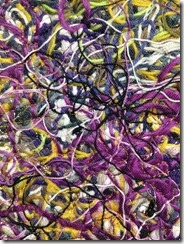
I used yarns of different thicknesses that reminded me of the dripped-paint lines in Pollock’s work.  But once I started dripping the yarn onto the white canvas background, I stopped thinking about Pollock’s paintings or my own plans, or really much at all.  All I cared about was adding line after line after line, only occasionally wondering where the next scribble of color should go… until the field was nearly covered.
working  Photo Oct 04, 1 17 12 PM  Photo Oct 06, 11 50 28 AM
The results are.. whatever they are.  But what was more important to me was the creative process itself. My approach was a mix of intuition, freestyle gestures and controlled composition.
I LOVE the effect of layers of lines on top of each other, creating a web of scribbles that fill my field of vision. Strands pulled out of a piece of gold foil fabric are mixed in with the yarn, adding little bits of reflected light.  As I stand and look at the gestures and movement of the lines, I can retrace my steps and re-live the wonderful experience of making this piece. This type of work is so unlike me (or my usual style) and yet I feel very deeply, personally connected to it.
KThemel_Lines
Lines_detail
Technical details: Whole cloth white cotton background, various yarn, metallic and rayon threads, fusible web, acrylic tulle; hand-guided machine quilting
Finished size 40”H x 52”W

Urban Wagga


Urban Wagga 
22”w x 40”L [56 cm x 101.5cm]

The “making do” Australian utilitarian quilts called “waggas” inspired the making of this modern, urban wagga. Using rusted cotton from my stash, I rubbed textured surfaces around my home and in the neighbourhood. An old quilt was repurposed as the base onto which I stitched sections using red thread and a machine utility stitch. The embroidered pieces came from a doily bought at my local thrift store.

 Materials; cotton, silk, dye, oil paint stick, rusty objects, old quilt reused, threads

Techniques; rust dyed, rubbed, indigo dyed, embroidery, machine applique, machine pieced, machine quilted


On My Way

by Misik Kim


Last year I participated in the exhibition “Wearable Art – Inspiration in Thread” organized by the Museum.  At that time I made my work with a crazy quilt technique using old silk fabrics.
Crazy quilt is the best technique to connect the remaining pieces, Randomly.


This is from the catalog of the exhibition:
“Misik Kim has been working with quilt for a long time.
She experiments with dying fabrics to create good color matches and then thousands of times of cuts and sews to complete a work like Buddhist mandala pieces.
Life is a patchwork of thoughts and experiences and she continues to focus on this way of working”.

I like this sentence “Life is a patchwork of thoughts and experiences”.

 Size : 18 W  40 H


Crystallography

This is going to be kinda long, because I took a bunch of pics along the way- first I have to give a shout out to my pal Karen Stone http://www.karenkstone.com  who started me paper piecing years ago with her genius patterns.
ooh my favorite thing- a blank piece of paper-

I begin sketching the lines, stepping back often to make sure everything flows

Then I put some rough sewing lines in- they don't need to be accurate because I will make it up as I go along. 
each shape is numbered and also given a directional arrow-this entire piece of paper will be cut apart and become my pattern.

fun picking fabrics!  it's great to delve into my batik stash for a change.

each shape is cut from the main pattern and sewn individually

then they're reassembled with all of their edges folded under- this will be turned edge machine appliqué 

I sew them all down on my trusty Bernina

and then quilt it
voila-
Crystallography 40x45"
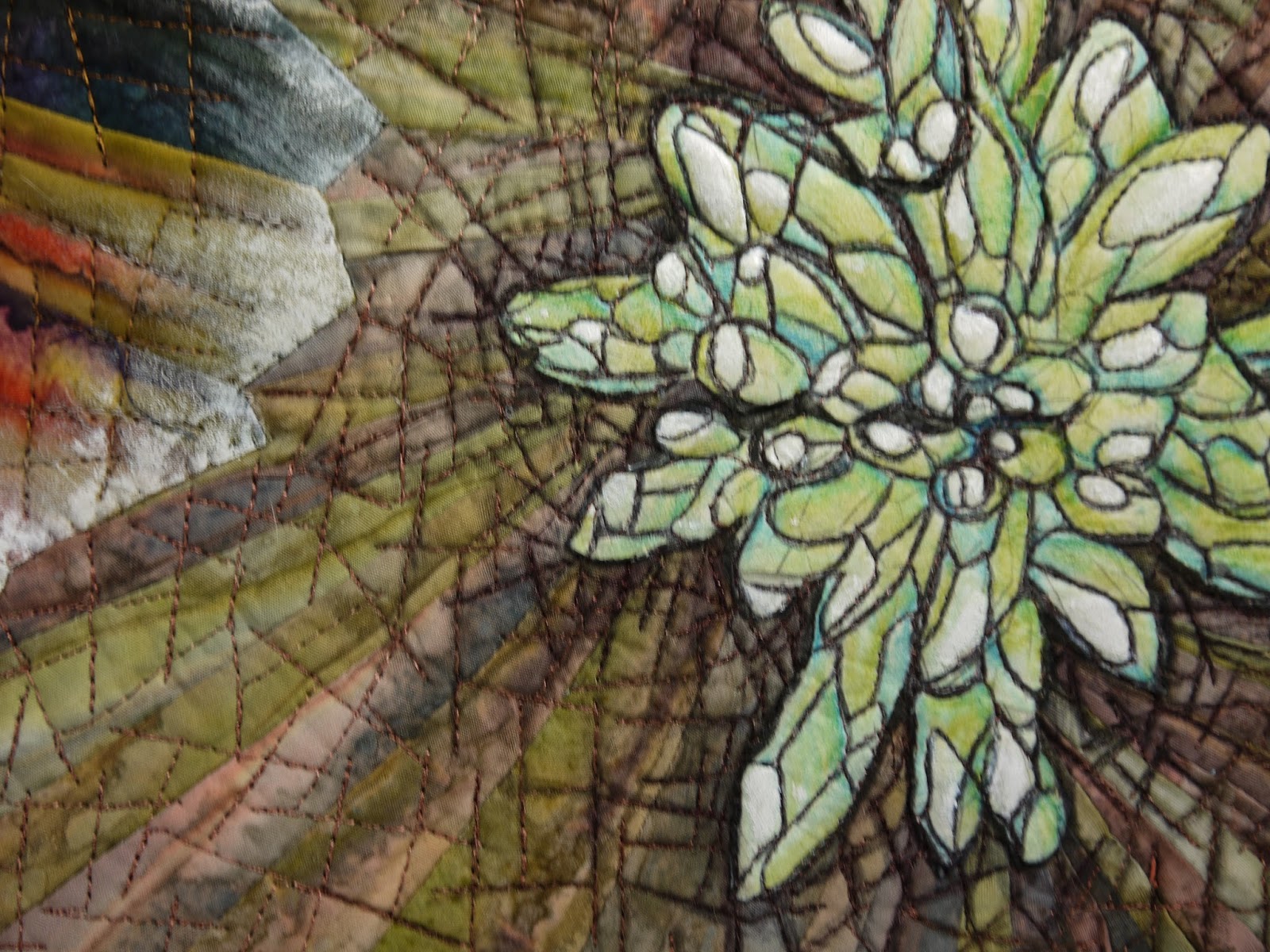
detail.

my theme this cycle is macro, I thought I would get inside the poky world of crystals instead of organic shapes for a change.

And Fortune Followed Her

I had already adopted Japan as home when my parents adopted my little sister Masako.  Having a little sister was a new idea to me.  I already had three brothers to vie with.   Masako being so  much younger was, instead, 'my' girl.  We were ten years apart in age, and because of our large family, we shared a room.  I didn't want her to forget her Japanese after we returned to the US so the two of us continued to talk, mostly about kid things.  I also bought her Japanese story books before we left.

Flying forward decades, Masako has a huge family of adopted siblings and she has reconnected with some of her Japanese family.  She is most cherished by us all.  She still speaks Japanese occasionally (and the Spanish of her husband's family).  
And Fortune Followed Her
As for my Japanese, I quit speaking it except for very brief questions for directions when I'm in country.  Several years ago I decided to take Japanese more formally.  My Japanese instructor did a lot of giggling covered by her soft fingers.  Guess what?  I spoke really nice "baby" Japanese.  Like Mr. Boat for boat...pretty undignified to say the least....perfectly legitimate for a 5 year old.

As for our tradition challenge,  I've used reference to Masako (and my adopted) textiles and techniques.  The abstracted kimono shape is a piece of kasuri cotton.  The shape was driven by the 40" height requirements and the amount of the fabric I had in my stash.  The sleeves were machine pieced, however, all the remaining stitching was done by hand, traditionally necessary.  The leaves which I interpret as 'letters from home' are a combination of over-dyed table linens and over-dyed cotton with newsprint imagery.  Vintage red buttons reference the fortune of family that welcomed Masako.